Vintage car revival
Dedicated enthusiasts in Zanzibar keep classic cars on the road
By Andrea Tapper
To be honest, comfortable it is not. Instead of a glove compartment, a sharp-edged metal rack. A metal handle to open the heavy car door.
And when Oliver Rashid in the driver’s seat pauses to show me a “most essential” little plastic bottle he is carrying along I guess it must be engine oil. But it’s not. It’s SPF 50 sunscreen. “This car has no roof”, Rashid says with a bright smile, “come rain, come shine I’m exposed to the elements.” Often, he has sought shelter under a Baobab tree together with dozens of boda-boda motorcycle drivers cheering him up.
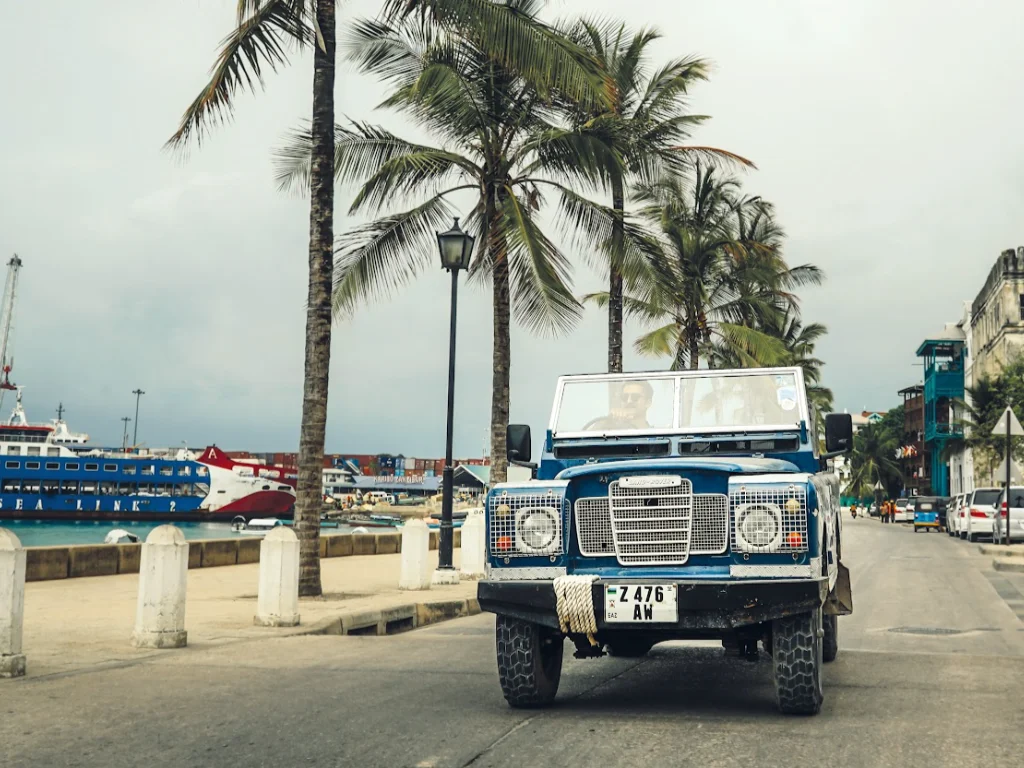
The 31-year-old is known in Zanzibar. He is the man with the blue Land Rover, Series 3, 109, built in 1982. That qualifies as a proper classic car which, by definition, has to be older than 40 years. It’s an open three-seater with a big loading area; exactly the car in which Queen Elizabeth II. loved to drive her corgis around Scotland. Talking of names, only Germans call antique, classic and vintage cars “oldtimers”.
Today Oliver Rashid and I are driving from the heart of Stone Town, on the charmingly restored seafront promenade, to Maruhubi, north of town. Our mission: to explore the passion for vintage vehicles – and what is left of it – in Zanzibar. In the spice-scented streets of Stone Town, where coral stone facades and carved doors tell centuries of stories, historic cars only occasionally roll into view – and if they do it’s more with dust and rust, than with chrome, leather and growling engines.
As if to test our resolve it starts raining – in February. Before we take off, we must of course inspect the hidden four-wheel treasures inside the Palace Museum (sadly closed to the public until further notice): a 1950’s Austin Morris formerly used by the British Embassy, and a light blue Ford Zephyr driven by the island’s first president Abeid Amani Karume until his assassination in 1972. The person telling us this is guide Khadija. She lets us explore a ghastly graveyard of half a dozen more vintage cars on the property – dusty shadows of their former glory, all beyond repair.
Our vintage safari continues: as people wave towards us, we hover though the old port of Malindi. The smell of fish and roasted chicken gets into the car. Oliver Rashid says, he likes it all, “the kids following me, the smells, the sounds, the all-around-view”. The rusted gear stick rather than automatic comfort. Born in Norway and the son of an oil engineer, with a grandfather from Zanzibar and a grandma from England, his love for cars developed early, and he became a car engineer at Land Rover in the British Midlands.
While working in Oman, in the late 90s, he developed the habit of choosing a car to fit the country, “of course it had to be a four-wheel-drive in Oman then.” When he moved to Zanzibar a good year ago, he reached out to relatives to find him a “nice classic car” – and the blue Land Rover was discovered.
Exploring new life and business opportunities – among them a local Spice Rum production – in the land of his forefathers, Oliver has invigorated the vintage car scene in Zanzibar since his return. A Land Rover club is in the making, the first 16 members have been recruited. In 2018, the late Park Hyatt Manager Nicolas Cedro – a big car enthusiast – organised the last oldies’ rally across the island. In other parts of East Africa there is already more glamour to vintage: in Nairobi, the Concours d’Elegance has become an annual highlight. The East African Safari Classic Rally – spanning Kenya and edging into Tanzania – furthermore demonstrates the region’s appetite for classic-car events.
Zanzibar’s revival has been quieter, but the spirit is here. Nassor El Mahruki, owner of the Mnarani (Lighthouse) Hotel in Nungwi and a dedicated sailor, is a vintage car lover by heritage. He takes care of a 1961 red and white Austin Cambridge, once driven by his father. Under El Mahruki’s supervision, the car – allegedly the same type was given to cabinet ministers after the revolution in 1964 – is still running, and has a beautiful cream and red interior: “I sometimes use it for first dates to pick up the lady”, the owner admits with a smile.
Meanwhile, Oliver Rashid has started to look after the island’s biggest car gem, a well maintained green 1959 Armstrong Siddeley, just as one of the Sultans had, now occasionally used to chauffeur VIP guests of the five-star Tulia hotel around. The hotel has built an air-conditioned garage for the vehicle to avoid rust. “Lack of parts, and a lack of mechanics are our biggest problem”, explains Oliver Rashid. “We often bring spare parts in our suitcases when coming back to the island.” These are the challenges, but passion is a powerful fuel.
When it all started, it was no different. The first classic cars brought by ship to Zanzibar added elegance to an otherwise rough environment. It was the time when explorer Dr. David Livingstone had given Zanzibar the much-quoted name “Stinkybar” referring to the waste-loaded former Darajani creek, then separating Stone Town from the rest of the island. The British began filling in the creek for hygienic reasons in 1915, a task only completed in 1957.
In those days, the best spot to parade your new old vehicle was the first paved street from Forodhani to the colonial post office, still in use on what is today’s Kenyatta Road. “There was a garage near the Majestic cinema, and one in Mkunazini where you can still see vintage cars parked today”, says Parmukh Singh Hoogan, the last Sikh in Zanzibar. Historians like Hoogan, old enough to remember pre-independence times, have become rare. “Around 1920, Zanzibar had only one kilometre of road but already a Rolls Royce garage”, the famous Goan historian John da Silva used to tell interested audiences in his legendary night lectures at the Emerson Spice hotel until his passing in 2014. I still remember da Silva’s words that “towards the end of the 19th century, Zanzibar was exactly the eighth richest city in the world – after New York, Paris, Berlin and others.” So, of course, when the first Rolls-Royce hit the light of day in 1906, it couldn’t be absent here. From the 1910s, the majestic vehicle, always in black, began circulating across the British Empire – including East Africa.
The Sultans preferred British luxury vehicles, colonial administrators liked Austin Morris. Land Rovers became popular in the late colonial period. How many vintage cars exist in Zanzibar today? “The question is not how many cars but how many running vintage cars”, Oliver Rashid corrects me. Without formal registry, estimates rank from
20-40 vehicles. It’s certainly a niche.
We are now heading to Maruhubi, ten kilometres out of town, a historic site in itself, where Sultan Bargash (1870-1888) allegedly kept 99 concubines. A huge, port-related construction is going on here. In the midst of gravel, cement and sand we find Jamal Awadh, Director of Zanzibar Ferry Devco (ZF Devco), who oversees the imminent opening of a second roll-on-roll-off harbour for the island. The long-term plan is to have three ports: a historic, monument-protected harbour in Malindi; a private-public partnership port in Maruhubi for ferries and loose goods, and a new giant container port in Mwangapwani.
But today there is something more important: Maruhubi port director Awadh brought his “baby”, a beige 1984 lightweight Land Rover, originally a military vehicle, with him. The building surveyor belongs to a remarkable group of Zanzibaris returning to their home island after a solid career abroad. “The car and I have a strange relationship”, he tells me, “when she is not in a good mood, she can get very temperamental.” And now I realise what strikes me most about vintage car lovers: they are the most beautiful people to meet.
Share