The East Coast Surf is On
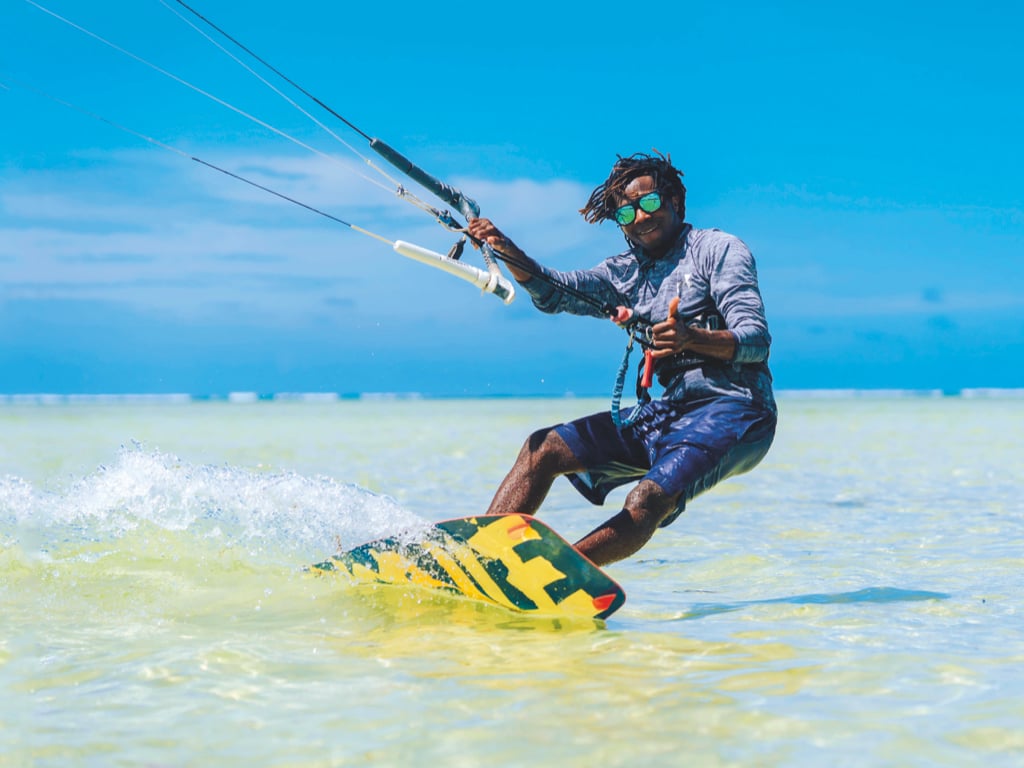
Warm water, wild wind and total freedom – Kiters’ heaven in Paje
At first glance, Paje looks too beautiful to be sporty. The beach is absurdly white. The Indian Ocean glows in fifty shades of turquoise. Masai sell rubber sandals. But then the wind arrives. Suddenly the horizon explodes with colour: red kites, blue kites, neon-green kites dancing above the lagoon like tropical birds on caffeine.
Zanzibar is now firmly parked on the list of the world’s top ten kitesurfing destinations. With reliable monsoon trade winds, warm shallow water and year-round tropical temperatures, the island has become a dream address. The holy grail is Paje on Zanzibar’s southeast coast. Here, an offshore coral reef forms a natural pool stretching hundreds of meters. Beginners love the waist-deep water, pros the buttery flat sections for freestyle tricks, and “normal” surfers the waves breaking further out on the reef. With more than 200 kiteable days a year, Zanzibar is mentioned alongside legendary spots like El Gouna in Egypt and Jericoacoara in Brazil.
Students range from eight to eighty years, surf instructors say. “It’s like riding a bike, once you know it, it’s forever”, says Bradley Thomas, 40, of “Aquaholics”, one of half a dozen established surf schools here. “Zanzibar just ticks a lot of boxes”, he says, “it has qualified schools and local pop-ups”.
Mbuzi, the quiet surfer
Away from the buzz and clubs of Paje, flanked by casuarina plants in Jambiani, Othman Mwinyi opens a shed full of surf boards. His students call the 37-year-old Rasta Mbuzi (Swahili for goat), a school nickname which stuck. “Local pop-ups”, he repeats with a sigh, “there are these and those. Some learn how to kite and start teaching a month later.” Not so Mbuzi himself. After a professional training in the Netherlands, he opened his fully-insured Mbuzi Kite School.He also has a rescue boat: “Kitesurfing is still a dangerous sport”, he says gently. In general, however, Mbuzi and Thomas welcome the growing number of local instructors, “as long as they are qualified”. How can a customer tell? Pros ask USD 60-80 per lesson (less for 10-hour-courses); bargains of USD 20 per hour should be a warning sign.
More safety
Modern kitesurfing was born in the 1990s when two French brothers developed the inflatable kite system. Within a decade, a niche obsession became a full-blown lifestyle sport. In terms of safety, it has changed dramatically. New kites feature quick-release systems; schools in Zanzibar now teach internationally standardized safety protocols. And then there is the feeling. One moment your board is skimming silently over water, the next, the kite catches a gust and suddenly you’re floating above the lagoon with fishermen, dhows, seaweed farms and even cows beneath your feet. After all, you are in Africa.
My first time KiteSurfing
Jenny Dietzold, 40, about overcoming newcomer’s anxiety:
There’s a very specific kind of humility that comes from being dragged face-first through the Indian Ocean by a giant kite while a cheerful instructor calls out “relax your arms!” My partner and I signed up for a ten-hour beginner’s course for two with Aquaholics. At first, kitesurfing sounded glamorous: wind in your hair, effortless freedom. Well, you will get there. But before, count on: stumbling on the beach, learning how to control the kite before even touching the board. And that kite is powerful. Pull too hard, panic for a second. Kitesurfing felt completely counterintuitive to me. My instincts were wrong. If the kite speeds up, my natural reaction is to pull harder. Exactly what you should not do. Control comes from gentleness, not force.
Once we moved into the water, handling both the board and kite at the same time felt almost impossible. Then the thrill: the first few seconds on the board. Probably not elegant. But suddenly I was gliding across the water instead of sinking into it. Three seconds like winning the Olympics! By the end of the ten hours, we could both stand and ride for some time; we’ll definitely take more lessons in the new season.
Visit his page at Mbuzi Kite Center Zanzibar
Share