The Magic of Seaweed
How the miraculous ocean product became a stylish bestseller
Mwani means seaweed in Swahili. And Mwani is the first company on the island to turn the traditional ocean harvest into a lucrative, modern cosmetic business.
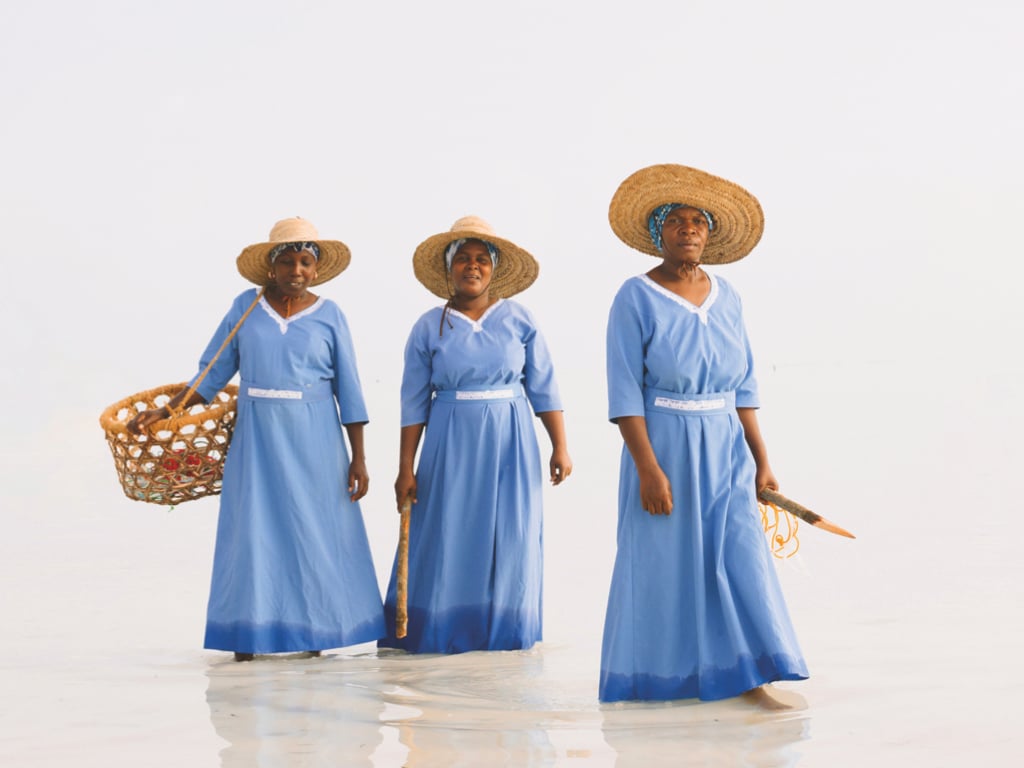
Everybody’s darling in Zanzibar is the blue economy. But few know what it is, or could be. At Mwani in Paje, a beauty business founded by Dutch national Klaartje Schade and her Tanzanian husband Andrew Anthony, everything is blue: the linen dresses of the mostly female seaweed farmers, the “Mwani Mamas”, the artistic glass bottles of the finished skincare products. And, five minutes away, the Indian Ocean. Its shallow waters are the cultivation and harvesting ground of the green gold.
We have come to join a guided tour of the seaweed plantation and lab. It is an eye-opener. “We were profitable right from the start,” says Schade, 38, mother of three and a former investment banker. The bungalow-style set-up is modest but combines traditional techniques with modern precision: a sterile production hall looks cleaner than an operating theatre; a makuti-roofed showroom invites customers to shop.
A global bestseller from Zanzibar
Mwani is one of the first global bestsellers hailing from Zanzibar. It has been featured in Vogue, Forbes and CNN and was named a “Top Innovator” by the World Economic Forum in Davos in 2024. It is used in luxury hotels across the region, and about a third of the production is exported. “The whole idea is,” explains Schade, who was born in Mozambique, “to create a genuine natural product which goes far beyond fair trade, a local product able to compete in the world.” She has turned the rough seaweed business into an aesthetic trend product – with sublime branding, photography, consistency and a clear scientific message.
“Let’s go to the sea,” says Pius Mwaisumu, general manager and our guide. With us is Pili, one of the Mwani farmers, in a striking blue uniform, carrying a self-made straw basket. We walk knee-deep into the water. There they are: rows and rows of wooden sticks, the very sticks tourists often wonder about. “Seaweed has no roots,” explains Mwaisumu. “We tie the sprouts to the sticks.”
Bracing ourselves against the wind, trying to find steady ground between coral holes, my joints start aching. Pili – and with her an estimated 23,000 female ocean farmers in Zanzibar – do the tough job for hours each day, stopping only when the high tide swallows the farm. “I like my job,” says Pili under her big straw hat, “although my back starts hurting after some hours.”
Seaweed farming has no season; the moon and tides dictate production. The sprouts are controlled and re-tied until they are ready to be harvested after about two months. The plant feels like rubber and is rich in fibre, minerals, iodine and antioxidant compounds.
100% natural skin superfood
It takes many hands and many women and a production cycle of about three months to turn the ocean harvest into a 100% natural skincare product. Back at Mwani, Pili leads us into the production lab, where drying and cooling devices hum. After being macerated at sub-zero temperatures, triple-filtered and evaporated, a tiny amount of potent macroalgae extract remains from a big harvest – the patented star ingredient of Mwani’s bestselling products. Tested in a South African laboratory, the “skin superfood”, as Mwani calls it, claims to “sculpt body shape, tighten facial contours, protect against free radicals and break down fatty acids”.
Seaweed has become a global green business, estimated at US$17 billion a year, supplying food, animal feed, fertilisers, cosmetics and pharmaceuticals. The sheet around sushi, known as nori, is made from edible seaweed too.
Because it needs no farmland, fresh water or chemical fertiliser, it is also a low-impact crop. Zanzibar has traded seaweed for generations; commercial farming began in 1989. Zanzibar produced 11,737 tonnes in 2023, an important source of coastal livelihoods although farmers receive only around 500 to 1,000 shillings per kilogram of dried seaweed. It takes a lot of sweat to harvest even that.
For Mwani women, however, the picture has changed. They earn ten to thirty times more with handmade luxury cosmetics than with raw dried seaweed. “This is definitely the future,” says Schade. “When we took over the seaweed firm ten years ago, it was a hugely unprofessional product.”
Today 180 suppliers, mostly women from tribal communities in East Africa, provide wild ingredients including unrefined Baobab and Marula seed oils, shea butter and mangrove honey. Mwani employs ten seaweed artisans. “It matters what you do and how you do it,” Schade insists.
Pili could not agree more. All women artisans here are trained in every part of the process, from planting and harvesting to making soaps and creams, to sending the products to wellness stores – sometimes as far as Beverly Hills.
Tapper
Get your dose of seaweed!
Book a tour: 90-minute immersive visit at Mwani in Paje, including a fresh seaweed fruit tonic, US$15.
All-in-one care: The bestselling “Face & Skin Superfood” lotion (photo below) can be used from head to toe. The “Facial Cleanser and Mask” with a honeylike texture becomes a mask when left on for ten minutes – making the two products the only skincare you need for the whole body. The price range is comparable to other luxury beauty brands, starting at US$97 per 200ml bottle.
Information & online shop: mwanizanzibar.com
Share